How much does YouTube pay per view in 2026? The direct answer is that YouTube does not pay creators a fixed amount per single view. Instead, creators are paid based on RPM (Revenue Per Mille), which is the estimated earnings per 1,000 views. In 2026, the average RPM for long-form content ranges from $1.50 to $10. This means that for 1,000 views, a creator might earn between $1.50 and $10; for 100,000 views, the earnings could be $150 to $1,000; and a video with 1,000,000 views can generate anywhere from $1,500 to $10,000. For YouTube Shorts, the revenue is significantly lower, typically yielding between $30 and $200 per 1 million views.
Frustrated by low YouTube earnings? Localizing videos to reach high-paying global audiences takes exhausting effort. VOMO solves this. Transcribe hours of audio with 99% transcription accuracy. It’s super fast—get transcripts in seconds to effortlessly translate your content and multiply your YouTube revenue.
1. Quick Answer: How Much YouTube Pays for 1,000 to 1,000,000 Views
The “Pay Per View” Myth
Many beginners believe YouTube pays a flat rate for every single video view. This is a common misconception in the creator economy.
YouTube does not pay for views directly. Instead, advertisers pay for ad impressions, and creators earn a share of that ad revenue.
Average Earnings Table (2026 Data)
Number of Views
YouTube Partner Earning
Other Earnings
1,000 – 10,000
$18 – $180
$50 – $500
10,000 – 100,000
$180 – $1,800
$500 – $5,000
100,000 – 1,000,000
$1,800 – $18,000
$5,000 – $50,000
As of 2026, available information suggests the following estimated earnings for long-form content. These figures depend heavily on your specific audience and niche.
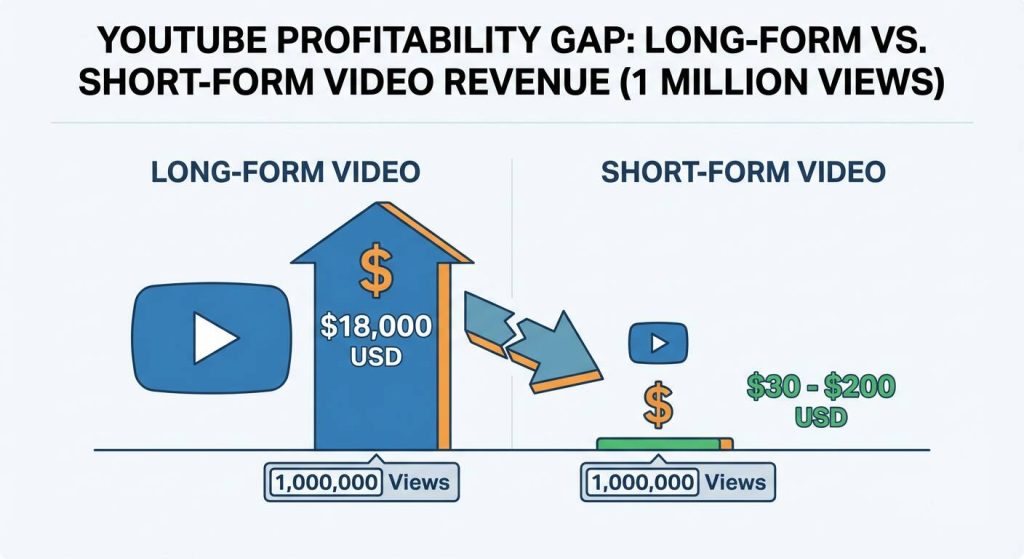
The Shorts vs. Long-form Gap
YouTube Shorts generate massive traffic, but their monetization model is entirely different from long-form videos. Advertisers pay much less for swipeable short content.
As of 2026, 1 million Shorts views typically yield only $30 to $200.
The following image compares the earning potential of YouTube long-form videos and shorts.
2. How Much Do Small YouTubers Make?
Earning for 10,000 Views Per Month
Small channels often wonder if it is possible to make a living early on. If your channel averages 10,000 views per month, your ad revenue will be modest.
Based on an average RPM, 10,000 monthly views will generate roughly $15 to $100. This is why small creators must rely on alternative income streams and learn how to save YouTube videos or repurpose content to grow faster.
3. How Do YouTubers Make Money? (7 Proven Ways)
Making money on YouTube goes far beyond just ads. Most successful creators combine several revenue sources to build stable, diversified income. Here’s a clear breakdown of the main ways YouTubers earn.
1. Advertising Revenue
For many creators, ads are the starting point. Once accepted into the YouTube Partner Program, you can earn from different ad formats such as skippable ads, non-skippable ads, bumper ads, and overlays.
Revenue depends heavily on your niche, audience location, and watch time. Finance and tech channels often earn significantly more per 1,000 views than entertainment or gaming channels. While ad income can be strong, it fluctuates with seasonality and advertiser demand.
Channel Memberships allow viewers to support creators through monthly payments in exchange for perks like exclusive badges, custom emojis, members-only posts, or bonus videos.
This creates recurring income, which is far more predictable than ads. However, creators must meet eligibility requirements, including age and regional availability, before enabling memberships.
For channels with loyal audiences, memberships can become a meaningful portion of total revenue.
3. Sponsorships
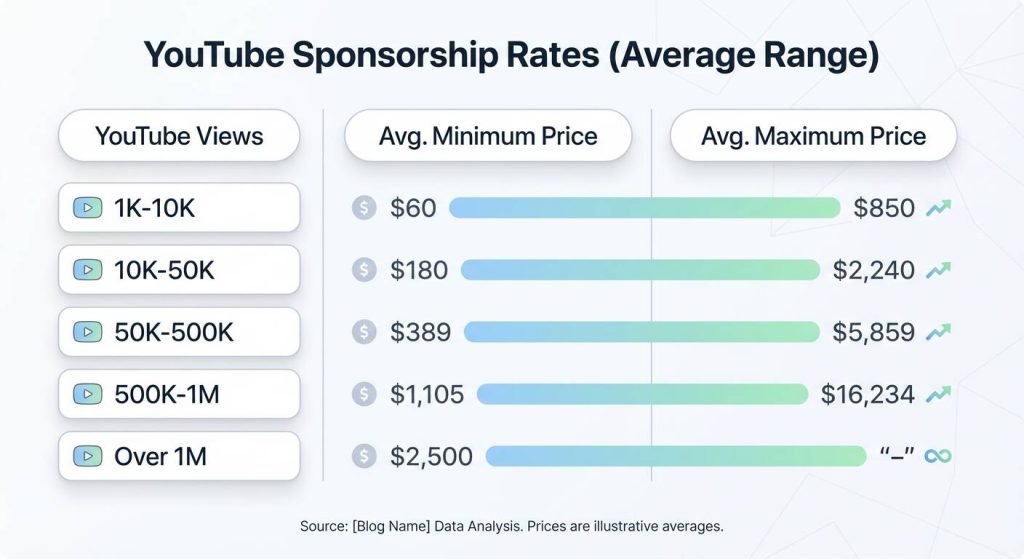
The following image shows the average price of sponsored YouTube videos worldwide in 2026 based on the number of views.
Brand deals are often the most profitable revenue stream. Companies pay creators to promote products or services directly within videos.
Rates vary widely based on views, engagement, and niche. Channels with strong audience trust can command premium pricing. In many cases, a single sponsored video can generate several times more income than ad revenue from the same number of views.
Industries such as tech, finance, fitness, and beauty tend to attract higher sponsorship budgets.
You may need to clip a YouTube video to send highlights to potential sponsors as part of your media kit.
4. Long-Term Brand Collaborations
Unlike one-off sponsorships, collaborations may involve multiple videos or extended campaigns. These agreements can include recurring promotions, product integrations, or ambassador partnerships.
Long-term deals offer greater stability and can significantly increase a creator’s overall market value.
5. Affiliate Marketing
Affiliate marketing allows creators to earn a commission when viewers purchase products through tracked links in the description.
This works especially well in product-driven niches like technology, online courses, software tools, and beauty. Commission rates vary by category. For higher-priced products, even a small percentage can generate meaningful income per sale.
Over time, affiliate income can compound as older videos continue generating sales.
For example, a tech YouTuber promoting a productivity software subscription might earn a 5% commission per sale. If the subscription costs $200, they would make around $10 for each person who signs up. With hundreds of sign-ups from a single video, this can quickly add up to a substantial income stream.
Top-performing YouTubers can earn from affiliate marketing tens of times more than their ad revenue.
6. Selling Merchandise
Once a creator builds a recognizable brand, merchandise becomes a natural extension. This can include clothing, mugs, digital products, courses, or branded accessories.
Merch transforms viewers into customers and often produces higher profit margins than ads. Many large creators, including MrBeast, have built entire product lines that operate alongside their channels.
7. Patreon and Direct Fan Support
When ad revenue alone is not sufficient, many creators use platforms like Patreon to receive direct financial support from fans.
Supporters typically subscribe monthly in exchange for exclusive content, early access, behind-the-scenes material, or private communities. This model works particularly well for documentary filmmakers, educators, artists, and niche creators with highly engaged audiences.
The Bottom Line
The most financially successful YouTubers rarely rely on a single income source. By combining ads, sponsorships, memberships, affiliate sales, merchandise, and fan support, creators build a diversified revenue structure that protects them from platform changes and fluctuating ad rates.
4. Understanding YouTube Revenue Logic: CPM vs. RPM in 2026
CPM (Cost Per Mille)
CPM stands for “Cost Per Mille” (Cost per 1,000 impressions). This is the gross metric showing what advertisers are willing to pay YouTube.
A high CPM indicates that advertisers find your audience highly valuable. Financial and business audiences usually command the highest CPMs.
RPM (Revenue Per Mille)
RPM stands for “Revenue Per Mille.” This is the most crucial metric for creators because it represents your actual take-home pay.
RPM includes ad revenue, YouTube Premium revenue, and Super Chats, calculated per 1,000 actual video views.
The 55/45 Split
YouTube does not give creators 100% of the ad money. The platform operates on a strict revenue-sharing model.
For traditional long-form videos, creators keep 55% of the revenue, while YouTube retains the remaining 45%.
6. Top 4 Factors Influencing Your YouTube Income
Niche (The Money Factor)
Your content category dictates your earnings more than your view count. Advertisers pay premiums for specific buyer intents.
High-paying niches: Finance, SaaS, Insurance.
Low-paying niches: Pranks, Gaming, General Vlogs.
Audience Location
Where your viewers live directly impacts your RPM. Advertisers bid higher for audiences with stronger purchasing power.
Views from the USA, Norway, and Switzerland generate significantly more revenue than views from developing nations.
Durée de la vidéo
The length of your video determines how many ads you can place. This is a critical factor for maximizing revenue.
Videos longer than 8 minutes are eligible for mid-roll ads. Placing strategic mid-rolls can instantly double your RPM.
AI Metadata Optimization
Search algorithms rely heavily on metadata to match videos with high-paying ads. Accurate subtitles and descriptions are vital.
Using AI-generated transcripts ensures your target keywords are embedded natively, attracting premium advertisers.
YouTube’s Highest-Earning Niches
In general, industries that are profitable in real life also tend to earn more on YouTube. You can use this as a guide to choose the niche you want to focus on.
Certain niches consistently generate higher earnings on YouTube due to strong advertiser demand and audience engagement. Among the top-paying categories are technology, finance, health, automotive, and investment-related content. Brands are often willing to pay more to reach viewers in these areas, resulting in higher CPMs for creators.
In recent years, other niches such as gaming, kids’ content, and educational channels have also become highly profitable, attracting significant ad spend.
At the same time, entertainment content continues to dominate in terms of views, making it a powerful combination of high traffic and potential earnings. Creators who focus on these niches can often maximize both revenue and audience growth.
7. Using Money Calculators To Check YouTuber Earnings
Top 3 YouTube Income Calculators
If you want to estimate your competitors’ earnings, several third-party tools provide surprisingly accurate estimates based on channel traffic.
Click the links below to access these calculators directly.
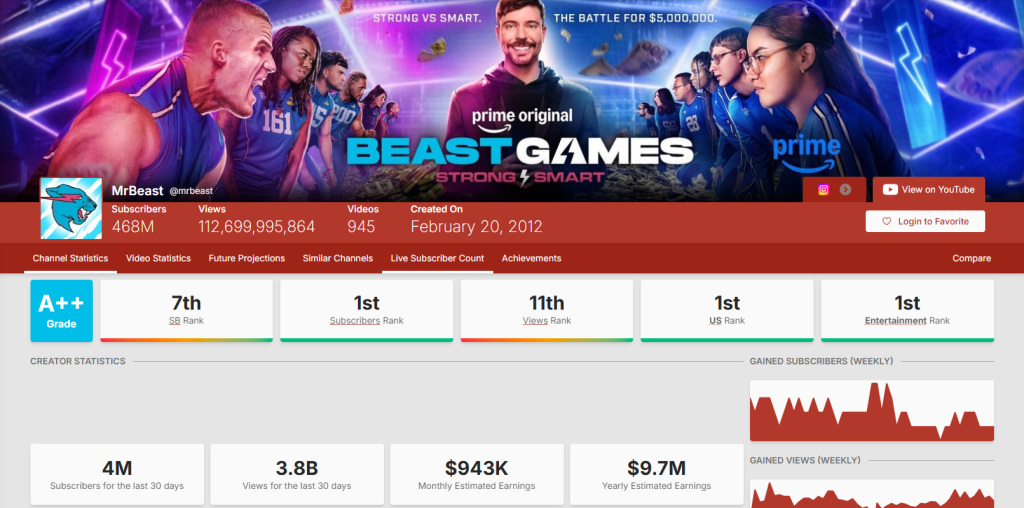
Social Blade: The industry standard for tracking daily views and estimated revenue ranges.
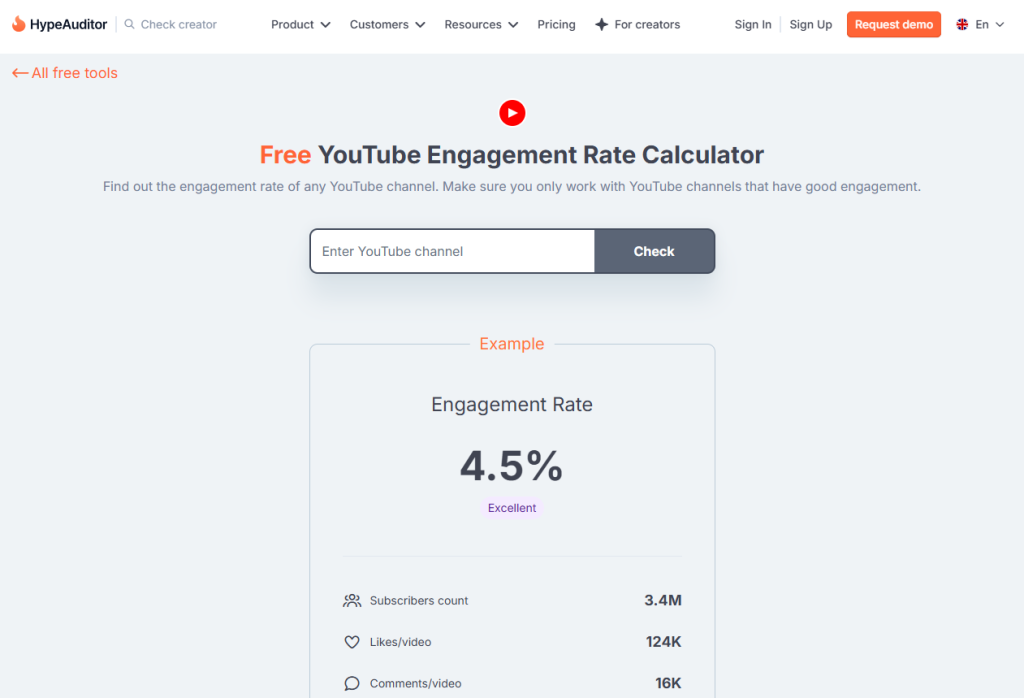
Hype Auditor: Excellent for analyzing audience demographics and influencer marketing value.
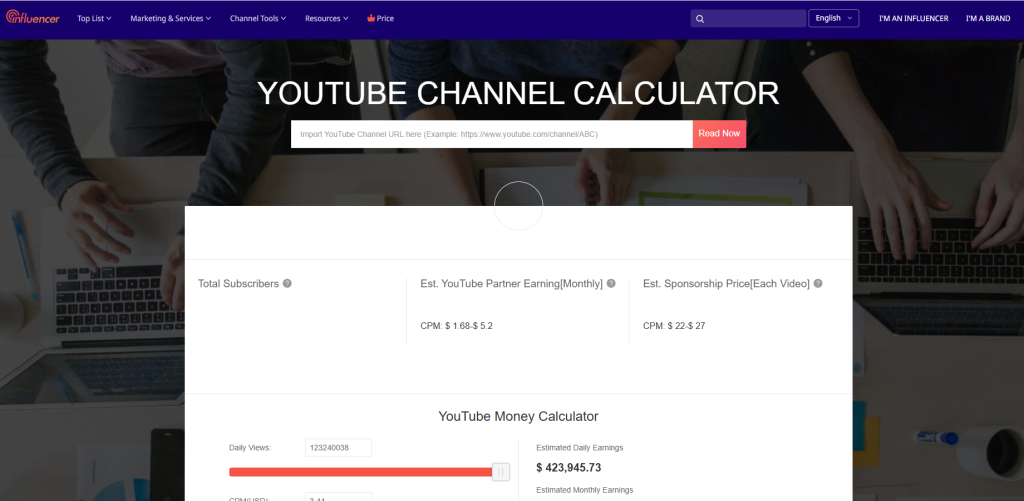
Nox Influencer: Provides localized data and estimates global channel valuations.
8. YouTube Partner Program (YPP) Thresholds for 2026
Standard Level
To earn a share of ad revenue, you must first be accepted into the YouTube Partner Program.
Subscribers: Minimum of 1,000.
Watch Time: 4,000 valid public watch hours in the last 12 months.
Alternative: 10 million valid public Shorts views in the last 90 days.
Fan Funding Access
YouTube introduced an “Early Access” tier to help smaller creators monetize sooner through Super Chats and Memberships.
Subscribers: Minimum of 500.
Watch Time: 3,000 valid public watch hours.
Who Can Monetize His YouTube Channel
Before you can start earning on YouTube, there are several essential requirements every creator must meet. Ensuring these are in place will make your channel eligible for monetization and other revenue opportunities.
Enable 2-Step Verification: Your Google account must have 2-step verification activated for added security.
Set Up an AdSense Account: You need a linked AdSense account to receive payments. If you don’t have one, it can be created directly through YouTube Studio.
Maintain Community Compliance: Your channel should not have any strikes or violations of YouTube’s community guidelines.
Be in a Supported Region: Monetization is only available in countries where the YouTube Partner Program operates.
Follow Monetization Policies: Your content must comply with YouTube’s monetization rules and standards.
Subscriber Threshold: Your channel needs a minimum of 1,000 subscribers to qualify.
Watch Hours Requirement: Accumulate at least 4,000 valid public watch hours within the past 12 months.
Shorts Views Requirement: Your shorts must have over 10 million valid public views in the last 90 days.
Once all these criteria are met, your channel becomes eligible to earn revenue, opening up opportunities for ads, memberships, and other monetization streams. For best results, pay attention to strategies like optimal posting times, which can significantly boost your views and earnings.
9. Success Stories: Richest YouTubers 2026
Here are the estimated earnings of the most successful YouTubers.
YouTuber
Niche
No. of Views
Annual Earnings
Mr. Beast (Jimmy Donaldson)
Entertainment, Social
93.7 billion
$85 million
Dhar Mann
Motivational, Short Films
18.4 billion
$56 million
Jake Paul
Fitness, Music
7.8 billion
$50 million
The Power of Personal Brands
Looking at the richest YouTubers in 2026 proves that ad revenue is just the beginning. Top creators leverage their views to build massive retail empires.
Creators like MrBeast reinvest their ad revenue into global businesses (like Feastables), proving that attention is the ultimate currency in the modern creator economy.
10. Conclusion: Average YouTube Pay Is $2.91 CPM
Ultimately, how much YouTube pays per view depends entirely on the demographic value of your audience. The final verdict for 2026 is that the global average YouTube CPM is around $2.91.
To thrive, creators must focus on increasing their RPM by combining ad revenue with sponsorships and merchandise. By leveraging AI tools for translation, repurposing, and metadata optimization, you can break geographic limits and maximize your revenue potential.