How to Take Good Meeting Notes: Best Practices, Examples, and Templates

立即将音频转化为文本

99% 精确 - 超快 - 易用

how to take good meeting notes best practices, examples, and templates

Taking effective meeting notes means capturing decisions, key discussion points, and clear next steps, not writing down everything people say. Good meeting notes help teams stay aligned, remember what was agreed on, and turn conversations into action. When done well, meeting notes reduce confusion, prevent repeated discussions, and make meetings genuinely productive.

AI has completely changed the way meeting notes are created. Advanced AI meeting note tools like VOMO come with built-in recording and transcription features, along with a wide range of meeting note templates. They make it easy to turn any meeting into clear, well-structured, and polished meeting notes.

In many cases, creating great meeting notes is really about choosing the right AI meeting note tool.

VOMO 将视频转换为文本

Summary: How to Take Better Meeting Notes That Actually Work

To take good meeting notes, prepare before the meeting, focus on outcomes instead of transcripts, structure your notes clearly, and share them promptly. The most effective notes document what was decided, who is responsible, and what happens next, creating a reliable reference for both attendees and those who couldn’t join.

什么是会议记录?

会议记录 are a practical record of the most important information discussed during a meeting. They typically include agenda topics, key points, decisions, and action items. Unlike formal records, meeting notes are flexible and can be adapted to personal or team preferences.

In real work environments, meeting notes are often used by project managers, team leads, and individual contributors to track progress and responsibilities between meetings.

什么是会议记录?

会议记录 are a formal and structured record of a meeting. They are commonly used in legal, regulatory, or governance contexts where documentation must meet specific standards.

Meeting minutes usually include:

  • Meeting date, start time, and end time
  • 与会者和缺席者姓名
  • Topics discussed
  • Motions, decisions, approvals, or rejections
  • Scheduled date of the next meeting

The term comes from the Latin minuta scriptura, meaning “small notes.” Importantly, minutes are not meant to be a word-for-word transcript, but an official summary of outcomes.

Meeting Notes vs Meeting Minutes: Key Differences

meeting notes vs meeting minutes key differences

While both record meetings, they serve different purposes.

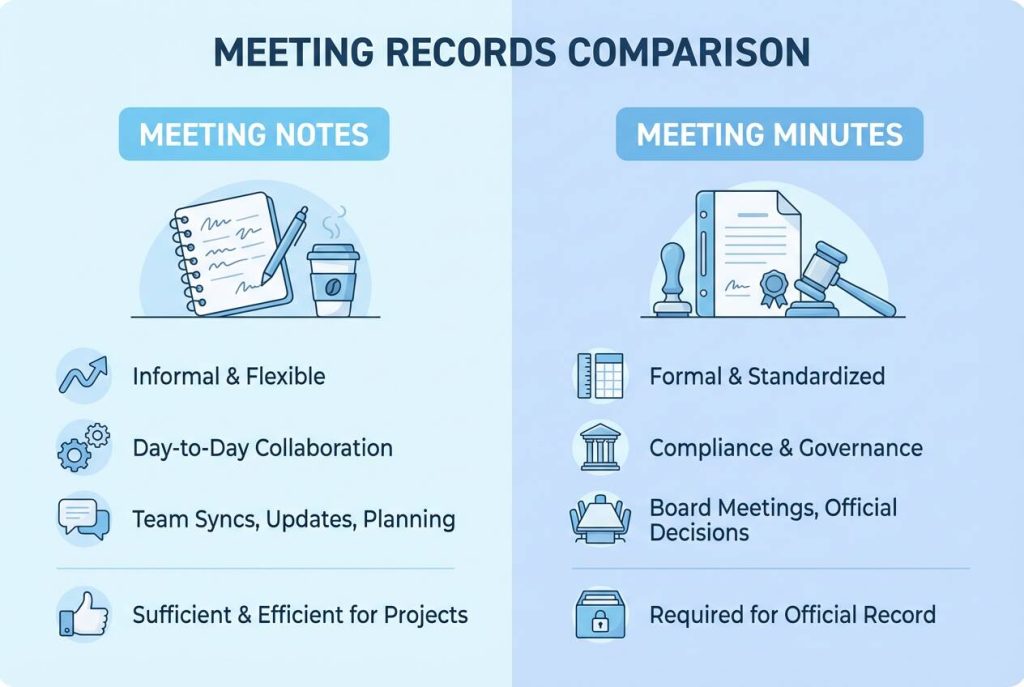
Meeting notes are informal, flexible, and optimized for day-to-day collaboration. They work well for team syncs, project updates, planning sessions, and one-on-one meetings.

Meeting minutes are formal, standardized, and often required for compliance or governance. They are commonly used for board meetings, public hearings, or official organizational decisions.

For most project and team meetings, meeting notes are sufficient and more efficient.

Why Taking Good Meeting Notes Matters

Document Decisions Clearly

Decisions made during meetings are easy to forget or misinterpret later. Written notes create a timestamped reference that clarifies what was agreed on and why. This helps avoid disputes and keeps teams accountable over time.

In practice, teams that store meeting notes in a shared location reduce follow-up questions and repeated discussions, especially during long projects.

Enable Asynchronous Participation

Not everyone can attend every meeting. Sharing meeting notes allows absent team members to catch up on decisions and context without needing another meeting. This is especially valuable for distributed or cross-time-zone teams.

Asynchronous access to notes gives people time to process information thoughtfully instead of reacting in real time.

Improve Memory and Recall

Psychologist Hermann Ebbinghaus demonstrated through his “forgetting curve” that people forget newly learned information rapidly without reinforcement. Reviewing written notes shortly after a meeting significantly improves retention.

Teams that revisit meeting notes even once within 24 hours are more likely to remember decisions and follow through on commitments.

What to Include in a Good Meeting Notes Format

Agenda Items and Discussion Points

Organize notes around the agenda to keep them structured. Under each topic, summarize the main discussion points instead of recording every comment.

This approach makes notes easier to scan later and helps readers understand context quickly.

Action Items and Next Steps

Every productive meeting should result in clear actions. For each action item, note:

  • What needs to be done
  • Who is responsible
  • Any relevant deadline

This turns conversations into execution.

Ideas, Decisions, and Key Takeaways

Capture ideas that may be revisited later, major decisions that affect the project, and key takeaways that summarize the meeting’s outcome. These elements are often the most valuable part of meeting notes.

Meeting Notes Templates and Examples

Using a consistent meeting notes template saves time and ensures nothing important is missed. Common templates include:

  • Team meeting notes
  • Project update notes
  • Client meeting summaries
  • One-on-one meeting notes

Templates also help teams know exactly where to find decisions and action items across different meetings.

Of course, this process has become extremely simple. Advanced 人工智能工具 come with a wide range of meeting note templates for different scenarios. They can automatically select and apply the right template, so there’s no need to fill anything out manually, and you don’t even need to download or upload templates yourself.

meeting notes templates

How to Take Meeting Notes Step by Step

Step 1: Prepare Before the Meeting

Review the agenda and meeting goals ahead of time. Set up your note format in advance so you can focus on listening instead of formatting during the meeting.

Preparation helps you recognize what information matters most.

Step 2: Record Key Information During the Meeting

Focus on outcomes, not verbatim transcription. Write down decisions, disagreements, risks, and next steps. Use bullet points and short phrases to keep up with the discussion.

Many experienced note-takers rely on abbreviations and symbols to capture ideas quickly.

Step 3: Organize and Structure Notes After the Meeting

Shortly after the meeting, clean up your notes. Group related points, clarify unclear references, and ensure action items are easy to identify.

This step often takes just a few minutes but greatly improves note quality.

Step 4: Review and Share Your Notes

Before sharing, check accuracy and completeness. Then distribute the notes to all relevant stakeholders so everyone has the same understanding of what happened and what comes next.

Timely sharing reinforces accountability.

Best Methods for Taking Meeting Notes

meeting note taking methods comparison

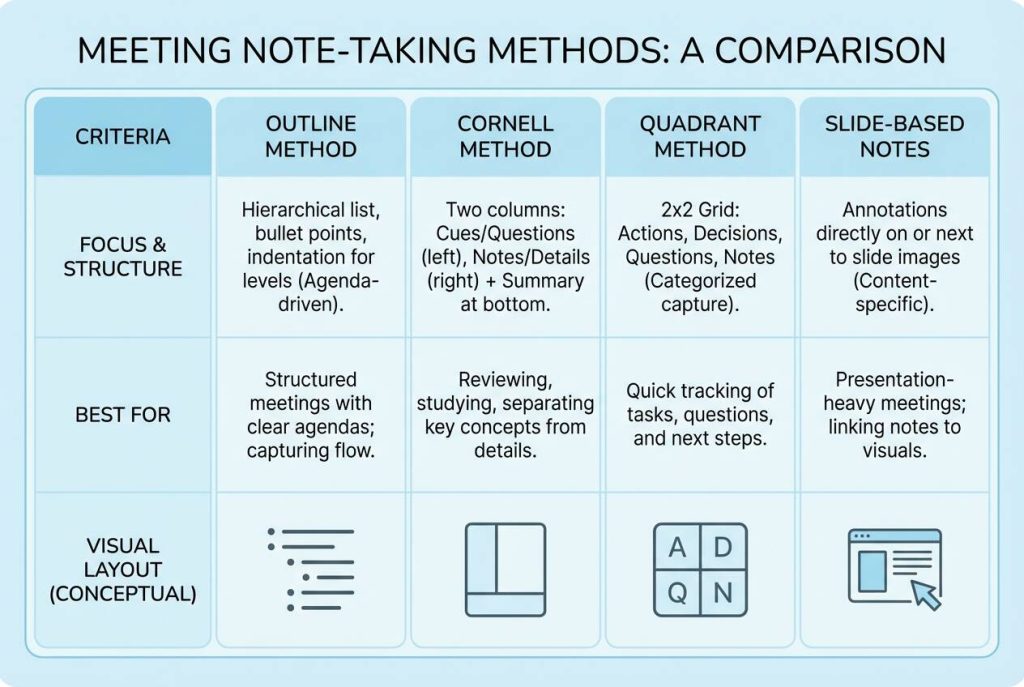
Different methods work for different people:

  • Outline method for agenda-driven meetings
  • Cornell method for separating key ideas and details
  • Quadrant method for tracking actions and questions
  • Slide-based notes for presentation-heavy meetings

Choosing a method that matches your role and meeting type makes note-taking easier and more effective.

Digital vs Handwritten Meeting Notes

Research shows handwritten notes can improve conceptual understanding because they force you to summarize rather than transcribe. Digital notes, however, are easier to share, search, and store.

Many professionals use handwritten notes during meetings and digitize them afterward for long-term storage.

10 Proven Tips for Taking Effective Meeting Notes

Taking clear and actionable meeting notes is one of the most effective ways to ensure your team stays aligned, follows through on tasks, and preserves valuable discussions. Below are ten proven tips, backed by research and real-world practices, to help you capture better meeting notes.

1. Choose a note-taking method that fits your style

Not all note-taking methods work for everyone. Pick a system that matches your role, learning style, and meeting type.

Examples of methods:

  • Cornell Method: Divide your page into two columns—key points on the left, detailed notes on the right. This helps quickly locate important decisions later.
  • Outline Method: Use the pre-shared agenda as a framework, adding notes under each topic. Ideal for structured team meetings.
  • Quadrant Method: Split notes into four sections: general points, your action items, others’ action items, and questions. Useful for tracking responsibilities clearly.
  • Slide Method: If a presentation is shared, annotate notes directly onto slides to link discussion points with visuals.

Case in practice: A marketing team using the Cornell method reported 40% faster review times when preparing weekly reports, because key points were immediately visible.


2. Focus on decisions and outcomes, not everything said

Trying to capture every word wastes time and produces cluttered notes. Concentrate on decisions, action items, and next steps.

小贴士 Use shorthand, abbreviations, or symbols to capture ideas quickly without losing meaning.

Case: During a 90-minute product strategy meeting, a project manager recorded only key decisions and task assignments and later found that team members were 30% more likely to complete their action items on time.


3. Handwriting notes can improve memory retention

Research shows that writing by hand helps retain conceptual information better than typing. Pen-and-paper notes encourage active listening, reducing distractions like emails or multitasking.

例如 A team lead experimented with taking handwritten notes for one month and noticed improved recall of client requests during follow-ups, avoiding miscommunications that had previously caused delays.


4. Use templates to streamline note-taking

Templates provide consistency and speed up the note-taking process. Whether you’re taking 会议纪要formal minutes, a structured template ensures you don’t miss critical information.

例如 A software development team implemented a shared meeting note template including agenda items, action owners, and deadlines. They reduced post-meeting clarification emails by 50%.


5. Assign a dedicated note-taker

If the meeting host is facilitating, assign someone else to take notes. For recurring meetings, rotate the note-taker to give everyone experience and maintain engagement.

Case: In a cross-departmental weekly sync, rotating the note-taker led to more complete and accurate notes because each participant brought a fresh perspective on what information mattered most.


6. Record meetings as a backup, not a replacement

Use recording tools to complement your notes. Transcriptions from video or audio recordings make it easy to verify points and extract missed details.

Best practice: Inform participants that the meeting will be recorded, and store recordings in a shared location for team access.

Case: A remote team using automatic transcription software for Zoom meetings saved 2 hours per week in manual follow-up, while ensuring no decisions were lost.


7. Highlight task owners and deadlines clearly

Every action item should specify who is responsiblewhen it is due. This ensures accountability and reduces confusion.

例如 After a board meeting, a note included:

  • John: Prepare Q2 financial report by June 15
  • Mary: Present marketing strategy at next board meeting

This clarity led to 100% on-time completion of follow-up tasks.


8. Collaborate on notes in real time

If possible, use collaborative tools so multiple participants can contribute during the meeting. This allows corrections, additions, and ensures no important point is missed.

例如 Using a shared Google Doc, a product team captured ideas, decisions, and questions simultaneously, avoiding the common problem of fragmented notes from different attendees.


9. Share notes immediately after the meeting

Distribute notes to all participants as soon as possible. This reinforces accountability, allows asynchronous team members to catch up, and ensures actionable items are visible while they’re still fresh.

Best practice: Use project management or communication platforms (e.g., Slack, Teams, or a shared drive) for easy access and notifications.

Case: A sales team that shared meeting notes within 30 minutes of meetings reported a 25% faster follow-up on client actions.


10. Turn notes into a knowledge base

Meeting notes are valuable long-term resources. Organize them in a centralized repository so your team can reference decisions, lessons learned, and recurring issues.

例如 A project team used an AI-powered note-taking tool to automatically transcribe, summarize, and store meeting notes. Over six months, this knowledge base reduced duplicated work by 20% and helped new team members onboard faster.

How to Turn Meeting Notes into Action Items

After the meeting:

  1. Review your notes and extract all action items
  2. Clarify ownership and deadlines
  3. Communicate tasks clearly to participants

For example, a note like “Prepare quarterly report” becomes more useful when rewritten as:
“Prepare Q2 financial report by June 15.”

人工智能转录工具 make all of this much easier. They can automatically identify key points from meetings, extract action items along with their owners and deadlines, and even send email reminders to the responsible parties.

How to Use Meeting Notes to Build a Knowledge Base

Over time, meeting notes evolve from simple reminders into a powerful knowledge resource that can drive efficiency and decision-making across your team. When stored in a centralized, searchable location—such as a shared drive, company wiki, or project management platform—they offer tangible benefits:

  • Learn from past decisions: By documenting discussions and outcomes from weekly team sync-ups or cross-departmental meetings, teams can reference why certain choices were made, reducing the risk of repeating past mistakes. For example, a product team reviewing past sprint notes may notice recurring bottlenecks and adjust planning accordingly.
  • Onboard new members faster: New hires can quickly get up to speed by accessing historical meeting notes instead of relying solely on verbal explanations. A case study from a mid-sized tech company showed that new employees using centralized notes reduced their onboarding time by 30%.
  • Avoid repeating mistakes: When lessons learned and action item follow-ups are clearly documented, teams can proactively prevent errors from reoccurring. For instance, a marketing team storing post-campaign meeting notes was able to identify which messaging strategies underperformed and avoid repeating them in future campaigns.
  • Maintain institutional knowledge: Meeting notes preserve knowledge even if key team members leave, ensuring continuity. In distributed teams, virtual meetings documented in a searchable knowledge base can bridge time zones and enable asynchronous collaboration without losing context.

By treating meeting notes as a living knowledge asset rather than a static record, teams create a resource that fosters continuous learning, supports strategic planning, and ultimately accelerates organizational growth.

Final Thoughts: How to Take Good Meeting Notes That Get Used

Effective meeting notes are clear, concise, and actionable. They don’t try to capture everything—only what matters. By preparing in advance, focusing on outcomes, and sharing notes promptly, you turn meetings from time-consuming discussions into drivers of real progress.

Done right, meeting notes aren’t just documentation. They’re a tool for better decisions and stronger teamwork.

vomo 徽标
20250727 103817 22
解锁即时 Al 会议笔记
左麦穗

100,000 多名用户的信任

5 星级
右麦穗

无需信用卡