

Short answer: No—Claude AI cannot directly transcribe audio files.
Claude AI is a large language model designed to process and generate text, not audio. That means it cannot convert spoken audio into text transcripts on its own.
However, Claude can still play an important role in audio workflows. Once an audio recording has been converted into text using a dedicated transcription tool, Claude can analyze the transcript, summarize key insights, generate notes, and help turn conversations into structured content.
In other words, Claude works best after transcription, not during the speech-to-text process.
My Test — Claude Still Cannot Directly Transcribe Audio
When I first started using Claude for podcast and meeting workflows, I expected it to handle audio transcription directly.
I tried uploading audio files such as MP3 recordings and asked Claude to transcribe them. However, Claude was unable to process the audio file itself. Instead, it responded that it works with text input rather than raw audio data.
After testing multiple times, it became clear that Claude cannot natively convert speech to text. This explains why many users online are confused—Claude is extremely powerful for analyzing text, but it does not include a built-in speech recognition system.
Once I converted the audio into a text transcript using a transcription tool, Claude worked perfectly for summarizing and analyzing the content.
How to Work with Audio Files Using Claude AI
Although Claude cannot transcribe audio directly, you can still build an effective workflow by combining a transcription tool with Claude’s language capabilities.
1. Use a Dedicated Transcription Tool
First, convert your audio recording into a text transcript.
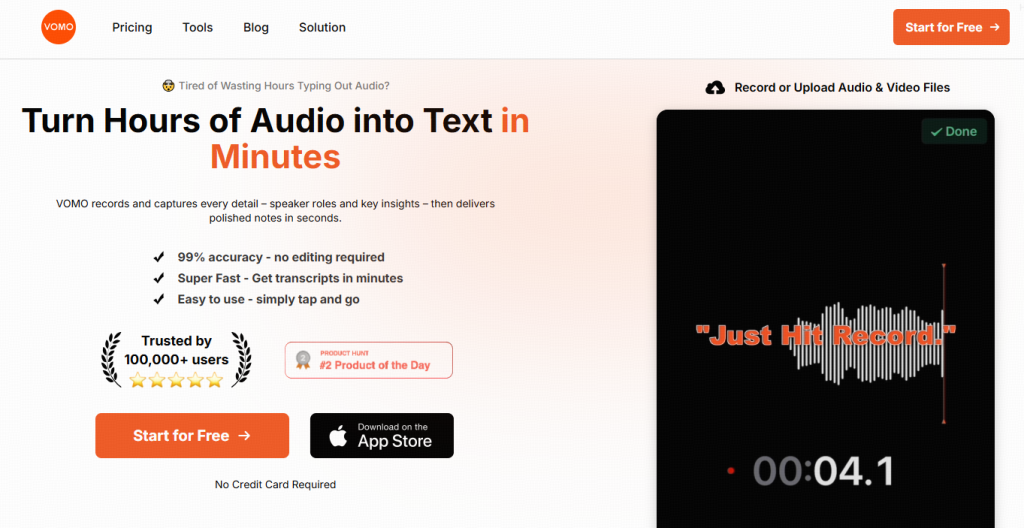
You can do this by using a transcription service such as VOMO AI, which converts audio or video files into accurate text transcripts in minutes.
Typical workflow:
Audio Recording
↓
Transcription Tool (e.g., VOMO)
↓
Text Transcript
Once the transcript is generated, it can be copied or exported for further analysis.
Transcription tools are designed specifically for speech recognition, making them much more suitable for converting spoken content into text.
2. Analyze the Transcript with Claude AI
After generating the transcript, you can paste the text into Claude and ask it to perform a wide range of language tasks.
For example, Claude can help you:
- Summarize long meetings or lectures
- Extract key insights and conclusions
- Identify action items from discussions
- Create structured meeting notes
- Rewrite or translate the transcript
Because Claude is optimized for language understanding, it performs extremely well when working with transcripts.
This makes it particularly useful for professionals who need to transform raw conversations into clear, actionable information.
3. Use Speech-AI Frameworks for Integrated Workflows
Some speech AI platforms combine speech recognition models with large language models like Claude.
For example, services such as AssemblyAI provide frameworks that automatically:
- Convert speech to text using a speech recognition model
- Pass the resulting transcript to Claude for analysis
This approach creates a more automated pipeline where transcription and language processing happen together.
It is especially useful for developers who want to integrate audio analysis into applications or enterprise workflows.
What Claude AI Is Good At in Audio Workflows
While Claude cannot generate transcripts itself, it excels at processing and understanding text derived from audio recordings.
Once a transcript is available, Claude can quickly turn long conversations into structured information.
Common use cases include:
Meeting summaries
Claude can convert meeting transcripts into concise summaries and highlight important decisions.
Lecture notes
Students can paste lecture transcripts into Claude and ask it to create organized study notes.
Podcast analysis
Claude can extract themes, talking points, and key quotes from podcast transcripts.
Interview insights
Journalists and researchers can analyze interview transcripts to identify trends or important statements.
In these situations, Claude functions as a powerful AI assistant for analyzing spoken content once it has been converted into text.
Why Claude AI Cannot Directly Transcribe Audio
Claude cannot transcribe audio because it does not include built-in speech-to-text capabilities.
Speech transcription requires specialized models trained to recognize spoken language, background noise, accents, and timing patterns.
Claude, on the other hand, is trained primarily to:
- Understand text
- Generate natural language
- Analyze written information
Because of this design, Claude cannot process raw audio files such as MP3 or WAV recordings.
To work with spoken content, the audio must first be converted into text using a dedicated transcription system.
Can Claude AI Transcribe YouTube Videos?
No. Claude cannot directly transcribe YouTube videos.
Claude does not have the ability to process video streams or extract audio from online video platforms.
If you want to analyze a YouTube video using Claude, you must first obtain a transcript of the video.
The typical workflow looks like this:
YouTube Video
↓
Extract Audio or Transcript
↓
Transcription Tool
↓
Text Transcript
↓
Paste into Claude
↓
Summarize or Analyze
Once the transcript is available, Claude can easily summarize the video, identify key ideas, or generate structured notes.
Using Claude AI for Video-to-Text Workflows
Although Claude cannot convert video to text directly, it can still be part of a video-to-text workflow.
The process usually involves two steps.
First, extract the audio track from the video file and convert it into a transcript using a transcription tool.
Second, paste the transcript into Claude to analyze the content.
This workflow allows you to combine accurate speech-to-text technology with Claude’s powerful language understanding.
For example, users commonly use this process to:
- summarize recorded webinars
- generate meeting notes from video recordings
- analyze interview footage
- extract highlights from long presentations
By separating transcription and analysis, you can still take full advantage of Claude’s strengths.
A Simpler Alternative for Audio Transcription
If you want a faster and simpler way to convert audio into text, tools like VOMO provide a more direct solution.
With VOMO, you can:
- Upload audio or video files directly
- Generate accurate transcripts automatically
- Extract summaries and key insights
- Identify action items from conversations
Unlike workflows that require multiple steps or integrations, VOMO allows users to convert recordings into structured text almost instantly.
This makes it especially useful for:
- students recording lectures
- professionals transcribing meetings
- creators summarizing podcasts or interviews
For users who simply need fast and reliable audio-to-text transcription, dedicated transcription tools are often the easiest option.
More Tools I Tested for Generating Transcripts Before Using Claude
Since Claude cannot generate transcripts directly, I tested several transcription tools to prepare audio files before analyzing them with Claude.
Some commonly used options include:
Whisper – an open-source speech recognition model that provides high transcription accuracy.
Otter.ai – a popular transcription platform for meetings and interviews.
VOMO AI – a simple solution that converts audio or video files into transcripts and automatically generates summaries and action items.
Once the transcript is generated, Claude can quickly transform that raw text into structured insights, summaries, or documentation.
Why Many People Think Claude Can Transcribe Audio
During my research, I noticed that many users online believe Claude can transcribe audio directly. This confusion usually comes from two situations.
First, some platforms combine speech-to-text models with Claude behind the scenes. In these cases, the transcription is actually performed by another AI model, and Claude is only responsible for analyzing the text afterward.
Second, certain developer tools such as Claude Code voice features or browser extensions can add voice-to-text functionality to Claude interfaces. However, these features rely on external speech recognition engines rather than Claude itself.
In reality, Claude still depends on a separate transcription system to convert audio into text.
Claude Is Excellent at Analyzing Transcripts
Although Claude cannot transcribe audio itself, it performs extremely well when working with transcripts.
In my tests, Claude was particularly good at:
- summarizing long podcast episodes
- extracting key insights from interviews
- identifying action items from meetings
- creating structured notes from lecture transcripts
For long recordings such as podcasts or workshops, Claude can turn thousands of words of transcript into clear and readable summaries within seconds.
Because of this strength, Claude is best viewed as an AI analysis tool for transcripts rather than a speech-to-text system.
When Claude Is Not the Best Choice
| Use Case | Why Claude Isn’t Ideal | Better Approach |
|---|---|---|
| Real-time transcription | Claude cannot process live audio streams or generate real-time captions. | Use dedicated live transcription tools. |
| Direct audio transcription | Claude cannot convert audio files (MP3, WAV, etc.) into text. | Use a speech-to-text tool first. |
| Automatic meeting transcription | Claude does not integrate with meeting platforms to auto-record and transcribe calls. | Use meeting transcription platforms. |
| Large-scale audio processing | Claude requires transcripts first, which adds an extra step in the workflow. | Use AI transcription tools with built-in speech recognition. |
Claude vs Gemini for Audio Transcription
Claude and Gemini handle audio transcription very differently.
Claude is a text-based language model, so it cannot process audio files directly. To work with recordings, you must first convert the audio into a transcript using a transcription tool, then paste the text into Claude for summarization or analysis.
Gemini, especially the latest Gemini 3.1 Pro, supports multimodal input and can process uploaded audio files in environments like Google AI Studio, allowing it to generate transcripts directly.
In short, Gemini 3.1 Pro is better for handling raw audio, while Claude is better for analyzing transcripts and extracting insights from text.
FAQ: Claude AI and Audio Transcription
Can Claude AI transcribe audio files?
No. Claude AI cannot directly convert audio files into text transcripts. You must first use a transcription tool to convert audio into text before using Claude for analysis.
Can Claude AI analyze transcripts?
Yes. Claude works extremely well with text transcripts. It can summarize conversations, extract insights, generate notes, and reorganize information from transcripts.
Can Claude AI transcribe YouTube videos?
No. Claude cannot transcribe YouTube videos directly. You need to obtain a transcript first and then paste it into Claude for analysis.
What is the best workflow for using Claude with audio?
The most effective workflow is:
Audio Recording
↓
Transcription Tool
↓
Text Transcript
↓
Claude AI
↓
Summary, Insights, or Notes
This approach combines accurate transcription with Claude’s powerful language processing.
Is Claude AI a speech-to-text tool?
No. Claude is not designed as a speech recognition tool. It is a large language model built for processing and generating text.
