

効果的 会議メモ are clear, structured, and action-focused. To write meeting notes that actually get used, you need to capture decisions, responsibilities, and next steps in a format that’s easy to scan and easy to share. The goal is not to record everything that was said, but to document what matters so teams can move forward without confusion.
This guide covers what meeting notes really are, how they differ from 議事録, what to include, proven note-taking methods, and how AI meeting noter tools can turn conversations into usable documentation.
You can simplify all of this with VOMO, an AI meeting noter that comes with dozens of built-in meeting templates and can automatically transcribe conversations and turn them into clear, well-structured meeting notes with minimal effort.

Why Writing Effective Meeting Notes Matters More Than Ever
Meetings are where alignment happens, but without メモ, decisions often disappear the moment the call ends. In real project environments, unclear notes lead to repeated discussions, missed deadlines, and accountability gaps.
Well-written meeting notes help teams:
- Reduce follow-up questions
- Preserve decision history
- Support async collaboration
- Keep projects moving without constant meetings
From a documentation perspective, structured meeting notes are also easier to search, reuse, and summarize later, which makes them far more valuable than raw transcripts.
What Are Meeting Notes (And What They Are Not)
Meeting notes are concise records of key points discussed during a meeting. They focus on outcomes, not full conversations.
Good meeting notes usually capture:
- Important discussion points
- 決定事項
- Action items and owners
- Context needed to understand why a decision was made
There is no single required format. In practice, effective meeting notes vary by team, role, and meeting type.
What Are Meeting Minutes and When to Use Them
Meeting minutes are a formal type of meeting documentation. They are often used in legal, regulatory, or governance settings where an official record is required.
Meeting minutes typically include:
- Date, time, and duration of the meeting
- Attendees and absentees
- Topics discussed
- Formal decisions, motions, or votes
- Scheduled next meeting
Despite the name, meeting minutes are not meant to capture events minute by minute. The term comes from minuta scriptura, meaning brief notes.
For most project teams, regular meeting notes are sufficient. Meeting minutes are best reserved for formal or compliance-driven meetings.
Meeting Notes vs Meeting Minutes: Key Differences
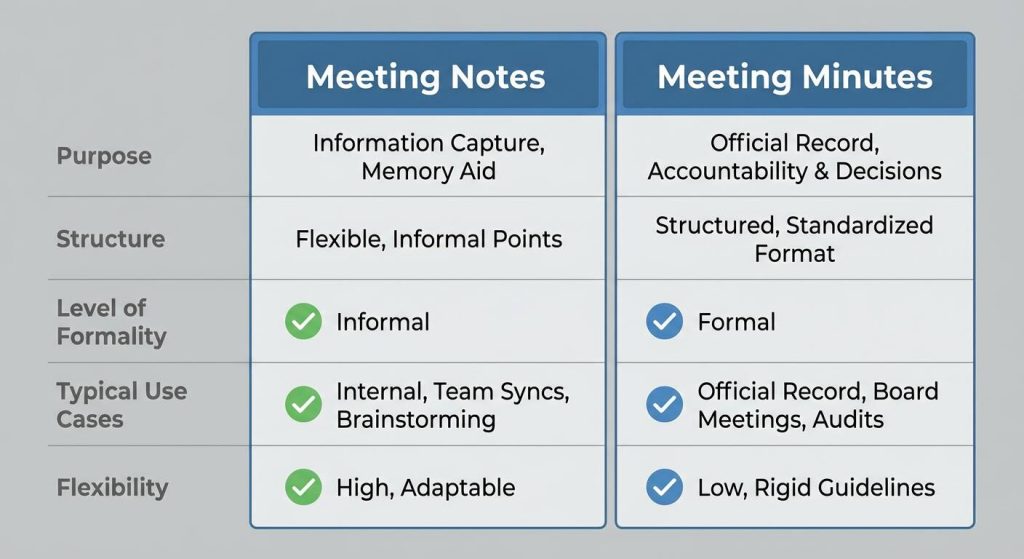
Meeting notes are flexible and practical. Meeting minutes are structured and formal.
用途 会議メモ for:
- Team syncs
- Project updates
- 1:1 meetings
- Planning sessions
用途 議事録 for:
- Board meetings
- Public or legal meetings
- Formal company proceedings
Choosing the right format prevents over-documentation while still protecting important decisions.
Benefits of Taking High-Quality Meeting Notes
Document Decisions Clearly
Even strong teams forget details over time. Written notes create a reliable record of what was decided and when, which helps resolve future disagreements and keeps projects accountable.
Enable Asynchronous Participation
Not everyone can attend every meeting. Shared notes allow absent team members to catch up without needing a second meeting, which is especially valuable for distributed teams.
Improve Memory and Recall
Research on memory shows that information fades quickly without reinforcement. Reviewing notes after a meeting helps retain decisions and context far better than relying on memory alone.
What to Include in an Effective Meeting Notes Format
A practical meeting notes template should include:
- Meeting title and date
- Attendees and roles
- Agenda items or purpose
- 主な論点
- 決定事項
- Action items with owners and deadlines
- Follow-up or next meeting details
These elements balance clarity with speed and make notes usable long after the meeting ends.
How to Write Meeting Notes Step by Step
ミーティング前の準備
Review the agenda and set up a simple note structure in advance. Knowing what topics will be discussed helps you focus on outcomes instead of scrambling to organize later.
Capture Key Information During the Meeting
Focus on meaning, not verbatim transcription. Write down decisions, responsibilities, and unresolved questions. Shorthand, symbols, and bullet points help you keep up.
Organize and Clean Up After the Meeting
Right after the meeting, review your notes while context is fresh. Clarify vague points, group related ideas, and highlight action items.
Share and Store the Notes
Distribute notes promptly so everyone has the same understanding. Store them in a central, searchable location so they can be referenced later.
Proven Note-Taking Methods for Meetings
Different meetings call for different techniques:
- Outline method: Follow the agenda and add notes under each item
- Cornell method: Separate key points from supporting details
- Quadrant method: Divide notes into general notes, your tasks, others’ tasks, and questions
- Slide-based notes: Add notes directly to presentation slides
The best method is the one you can use consistently without slowing down the meeting.
Common Mistakes That Make Meeting Notes Useless
これらの落とし穴を避けよう:
- Writing long, unstructured paragraphs
- Mixing discussion with action items
- Failing to assign task owners
- Leaving out dates and deadlines
- Using a different format every meeting
Consistency matters more than perfection.
How AI Meeting Noter Tools Improve Meeting Notes

AI meeting noter tools solve one of the biggest problems in note-taking: divided attention.
Instead of choosing between listening and writing, AI meeting noter tools can:
- Transcribe meeting audio automatically
- Identify key discussion points
- Extract decisions and action items
- Generate structured meeting notes in seconds
This is especially useful for recurring meetings, long discussions, or fast-paced conversations where manual notes often miss details.
In practice, teams using AI meeting noter tools save hours each week and produce more consistent documentation.
How to Turn Meeting Notes Into Clear Action Items
To ensure follow-through:
- Include a dedicated action items section
- Specify what needs to be done, by whom, and by when
- Review action items at the end of the meeting
- Share them clearly with all participants
例
“Prepare Q2 budget forecast — Owner: Alex — Due: June 15”
Clear ownership turns notes into execution.
Using Meeting Notes to Build a Team Knowledge Base
Over time, meeting notes become more than records. They become institutional knowledge.
When stored consistently, meeting notes:
- Preserve decision history
- Provide context for new team members
- Prevent repeated discussions
- Support continuous learning
AI meeting noter tools make this easier by creating searchable, structured notes that can be reused across projects.
Final Thoughts on Writing Meeting Notes That Get Used
Meeting notes work when they focus on clarity, decisions, and next steps. You don’t need perfect wording. You need structure, consistency, and follow-through.
Whether you write notes manually or use an AI meeting noter, the goal is the same: turn conversations into shared understanding and real progress. When done right, meeting notes stop being forgotten documents and start becoming a core productivity asset.