

To write a professional thank you note after a meeting, express gratitude immediately, reference a specific insight from the conversation, and confirm the next steps or action items. While many struggle to recall exact details after a long call, sending a note that includes a clear summary of the discussion transforms a simple courtesy into a valuable business asset.
VOMO 자동으로 turns recordings into structured meeting notes, allowing you to effortlessly include key points and decisions in your email to demonstrate reliability and attention to detail.
The “Value-First” Framework: Why “Just Saying Thanks” Isn’t Enough
In 2026, professional mailboxes are overflowing. A generic “Thank you for your time” email is often deleted immediately because it offers no value. To stand out, you must shift from a “politeness mindset” to a “value mindset.”
The most effective follow-up emails do three things:
- Validate: They acknowledge the time spent.
- Reinforce: They reference a specific insight or agreement from the meeting.
- Advance: They clearly state the next steps or 작업 항목.
2026 Trend: The “Recap” is the New “Thank You” Busy executives prefer a short summary over a long compliment. Sending a note that says, “Here are the 3 decisions we made,” is the ultimate form of professional gratitude because it saves them work.
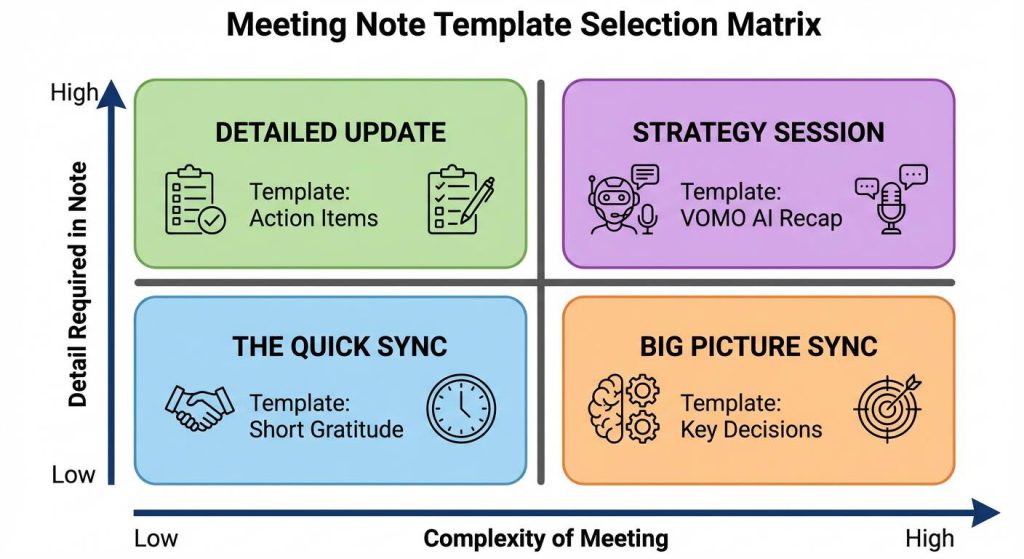
The Decision Matrix: Simple Note vs. Detailed Recap
Not every meeting requires a 500-word essay. Use this matrix to decide how much effort to put into your follow-up.
- Casual Coffee Chat / Intro: Keep it short (3-4 sentences). Focus on the relationship.
- Sales Discovery / Client Call: Medium length. Must include a summary of their pain points to show you listened.
- Internal Strategy / Project Kickoff: Long form. Must include a detailed recap of decisions and assigned tasks.
8 Professional Thank You Note Templates (Copy & Paste)
Here are tailored templates for the most common business scenarios.
Category 1: External Clients (Sales & Partnerships)
1. The “Moving the Deal Forward” Note Best for: After a discovery call where specific pain points were discussed.
“Hi [Name],
Thank you for sharing your challenges regarding [Specific Pain Point] today. I was particularly interested in your point about [Specific Detail].
As discussed, I will send over the proposal by [Date]. In the meantime, I’ve attached a brief summary of our conversation below to ensure we are aligned.”
2. The “Resource Share” Note Best for: Adding value by sending a relevant article or case study.
“Hi [Name],
Great connecting today. You mentioned you were looking for data on [Topic].
I found this report helpful and thought you might appreciate it: [Link]. Let’s chat next week about how this applies to your project.”
3. The “Clarification” Note Best for: When you need to answer a question you couldn’t answer live.
“Hi [Name],
Thanks for the time. During our call, you asked about [Specific Question].
I’ve confirmed with my team that [Answer]. I hope this helps clear up the blockers for our next steps.”
Category 2: Job Interviews (Post-Interview)
4. The “Reinforcing Fit” Note Best for: Reminding the interviewer why you are the perfect candidate.
“Hi [Name],
Thank you for discussing the [Role Name] position with me. I loved hearing about the team’s focus on [Company Goal].
Our conversation reinforced my belief that my experience in [Your Skill] would help you solve [Company Challenge] immediately. I look forward to the next steps.”
5. The “Specific Detail” Note Best for: Proving you were actively listening.
“Hi [Name],
Thanks for the interview. I’ve been thinking about your comment regarding [Specific Project], and I have a few ideas on how I could contribute to that initiative…”
Category 3: Internal Team & Managers
6. The “Project Update” Note Best for: Keeping stakeholders informed.
“Hi Team,
Thanks for the sync. To recap, we decided to prioritize [Task A] over [Task B].
작업 항목:
- [Name]: Complete draft by Friday.
- [Name]: Review budget.
Let’s regroup next Wednesday.”
7. The “Appreciation” Note Best for: Thanking a colleague for their help.
“Hi [Name],
Just wanted to say thanks for your input on [Project] today. Your idea about [Idea] really broke the deadlock. I appreciate your support.”
Category 4: The “VOMO Special” (AI-Enhanced)
8. The “Full Recap” Note Best for: Long, complex meetings where details matter.
“Hi [Name],
Thanks for the productive session. To save us both time, I used VOMO 를 생성하려면 구조화된 요약 of our discussion..
주요 의사 결정:
- [Point 1 from VOMO notes]
- [Point 2 from VOMO notes]
You can view the full transcript and action items here: [Link to VOMO Share]. Let me know if I missed anything.”
How to Use VOMO to Supercharge Your Follow-Up
The difference between a good thank you note and a great one is detail. But relying on your memory is risky.
Don’t Rely on Memory: Find the “Golden Quote”
Using VOMO, you can capture 99%-accurate transcripts with speaker identification. This allows you to search the text for exactly what your client said.
- Instead of: “Thanks for the feedback.”
- Write: “I really agreed with your point that ‘innovation requires friction’…”
From Audio to Action Items Automatically
You don’t need to spend an hour typing up notes. VOMO automatically turns recordings into structured meeting notes. Understanding what should and should not be included in meeting minutes ensures your follow-up is concise yet comprehensive.
If you forgot to ask a specific question during the meeting, you can use VOMO’s AI Q&A to ask the recording, “What was the budget deadline mentioned?” and get an instant answer to include in your note.
Speed Wins: Send Within 15 Minutes
The “Recency Effect” means people remember you best immediately after the interaction. Because VOMO processes recordings in minutes, you can send a highly detailed, impressive follow-up email before the other attendees have even returned to their desks.
Subject Line Mastery: Getting Your Note Opened
Your email is useless if no one reads it.
- The Specific Reference: “Great meeting you / Thoughts on [Topic]”
- The Value Add: “Recap of our call + Next Steps”
- The Question: “Quick follow-up re: [Project Name]”
The 24-Hour Rule Always send your note within 24 hours. After 48 hours, the emotional connection fades. With VOMO, you can aim for the “15-minute rule” to truly impress.
Conclusion: Build Relationships, Not Just Inboxes
In 2026, writing a thank you note after a meeting is no longer just about etiquette; it is a strategic tool for relationship building. A well-crafted follow-up that includes specific details and clear action items demonstrates your professionalism and respect for the other person’s time.
If you find yourself unable to make a session, knowing how to say you will not attend a meeting followed by an AI-generated recap is the gold standard for modern etiquette.
Consistency is key. By using these templates and leveraging tools like VOMO to instantly generate accurate summaries , you can transform the tedious task of follow-up emails into a high-leverage habit that keeps projects moving and clients engaged.