

Downloading audio from YouTube videos is useful for offline listening, research, and content repurposing. However, in 2026, the process is still more complicated than most people expect.
After testing multiple tools and workflows, the biggest challenge is not whether you can extract audio—but how to do it easily, safely, and without losing quality.
In this guide, we break down the best methods, common mistakes, and smarter alternatives depending on your goal.
If your goal is downloading visuals as well, you might also want to learn how to save YouTube videos.
The Real Workflow: YouTube → Audio Extraction → Format
No matter which tool you use, the process always follows the same structure:
- Copy the YouTube video link
- Extract the audio stream
- Convert or save it in a usable format
Understanding this helps avoid confusion when comparing tools.
Command Line vs Online vs AI: Which Is the Best Way to Download YouTube Audio?
| Method | Workflow | Ease of Use | Speed | Audio Quality | Safety | Scalability | Best For | Limitations |
|---|---|---|---|---|---|---|---|---|
| Command Line (yt-dlp) | Paste URL → Run command → Extract audio | ❌ Hard | ⚡ Fast | ✅ Highest (original format) | ✅ Safe (local) | ✅ High (batch & playlists) | Advanced users, bulk downloads | Requires technical knowledge |
| Online Converters | Paste URL → Click download | ✅ Very Easy | ⚡ Fast | ⚠️ Medium (often compressed) | ❌ Risky (ads, malware) | ❌ Low | Quick one-time downloads | Unstable, security concerns |
| AI Tools (Transcription / Processing) | Paste URL → Auto process → Get text/audio insights | ✅ Very Easy | ⚡ Very Fast | ⚠️ Not focused on audio files | ✅ Safe | ✅ High | Learning, research, content repurposing | Not designed for MP3 downloads |
Key Takeaways
- Command line tools provide the best quality and control but have a steep learning curve
- Online tools are the fastest to start but come with safety and reliability risks
- AI tools shift the workflow from downloading audio → extracting insights
Pro Insight (Based on Real Workflow Testing)
In real scenarios, the biggest difference is not speed—it’s efficiency and usability:
- Command line = powerful but complex
- Online tools = simple but unreliable
- AI tools = most efficient for content understanding
👉 If your goal is listening, download audio
👉 If your goal is learning, skip downloads and extract insights directly
Can You Legally Download Audio from YouTube?
Before choosing a method, it’s important to understand what’s allowed.
✔ Legal options include:
- YouTube Premium (offline playback only)
- YouTube Audio Library (royalty-free downloads)
- Content you own or have permission to use
🚫 Risks:
- Downloading copyrighted content without permission may violate YouTube policies
💡 If your goal is learning or analysis, converting audio to text (instead of downloading files) is often a safer alternative.
Official Methods: YouTube Premium & YouTube Music
YouTube Premium (Best for Offline Playback)
🔹 A paid subscription service that allows users to download videos for offline viewing, but not as separate audio files.
🔹 Works well for music, podcasts, and educational content.
🔹 Does not allow exporting files outside the YouTube app.
YouTube Music (Best for Downloading Songs)
🔹 If you need music, YouTube Music Premium allows downloading songs and playlists for offline listening.
🔹 Audio files remain within the app and cannot be exported as MP3s.
Method 1: Command-Line Tools (Best for Advanced Users)
Tools like yt-dlp offer the most control.
Example:
yt-dlp -x --audio-format mp3 URL
Pros:
- High reliability
- Supports playlists
- Flexible formats
Cons:
- Requires technical knowledge
- Not beginner-friendly
This is the most powerful—but least accessible—method.
Method 2: Online Converters (Fast but Risky)
Online tools allow quick conversion:
- Paste link
- Download MP3
Pros:
- Very easy
- No installation
Cons:
- Security risks (ads, malware)
- Often unreliable
- Quality inconsistencies
From testing, this method works—but is not dependable long term.
Method 3: Desktop Apps (Best Balance for Frequent Use)
Apps like 4K Video Downloader provide a middle ground.
Pros:
- Stable performance
- Supports playlists
- Easy UI
Cons:
- Requires installation
- Still limited by YouTube restrictions
This is ideal for users who frequently download content.
VOMO AI: The Smarter Alternative to Downloading YouTube Audio
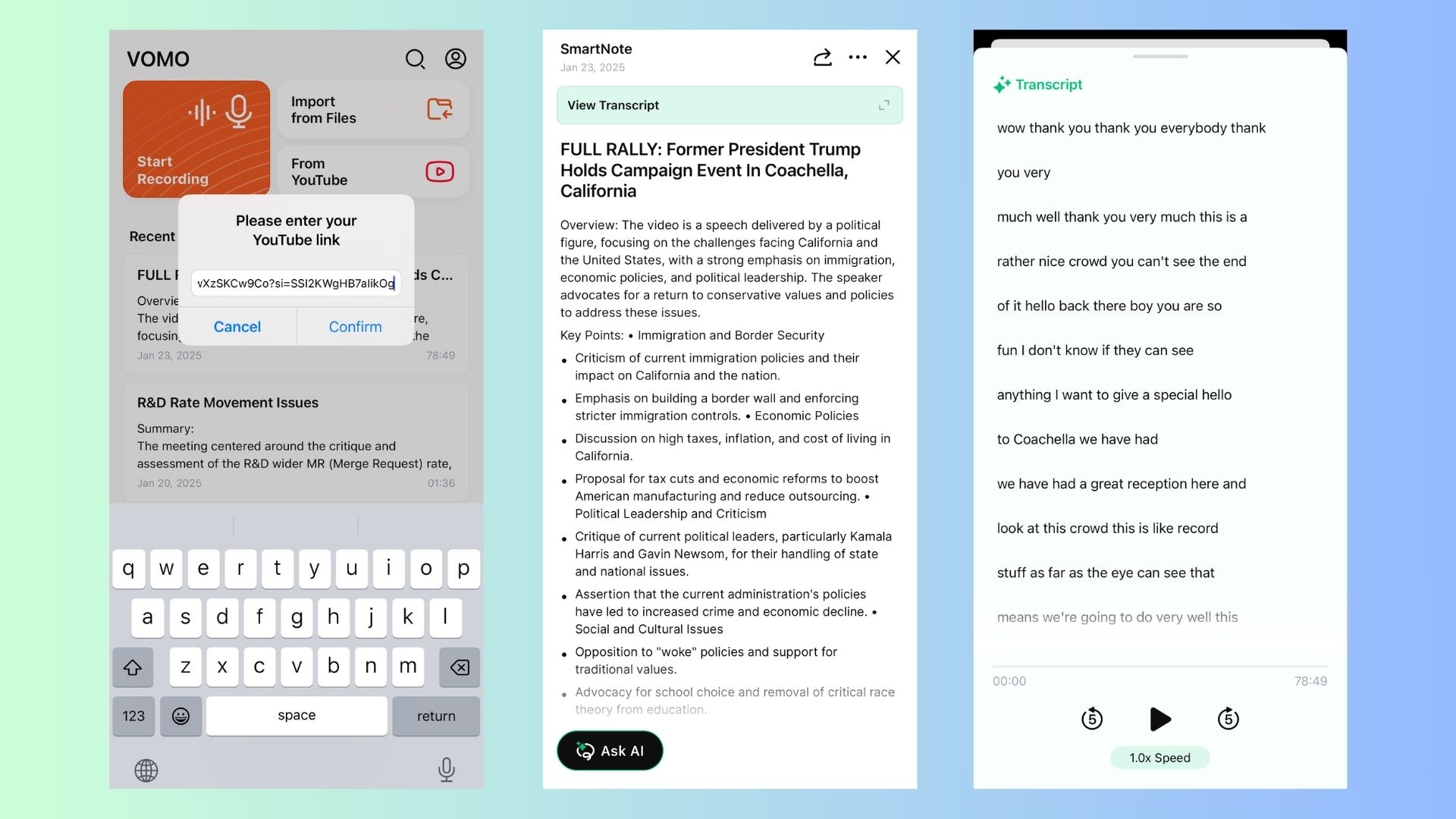
If your goal is to extract insights from YouTube videos rather than just downloading MP3 files, VOMO AI provides a legal and efficient alternative.
Why Use VOMO AI Instead of Downloading Audio?
✔ Transcribes YouTube videos directly from URLs – No need for manual downloads. It’s the most effective way to get a YouTube transcript instantly
✔ AI-powered summaries –Extracts key takeaways without listening to full videos, letting you summarize YouTube videos with AI in minutes.
✔ Multi-Language Support – Transcribes and translates content on YouTube in 50+ languages. If you’ve ever asked, “is there something that will translate YouTube videos to English?”, this is your solution.
✔ Works with Any YouTube Content – Interviews, lectures, podcasts, meetings.
✔ Shareable Note Links – Instantly create text-based summaries for collaboration.
💡 IInstead of cluttering your storage with audio files, use VOMO AI to turn video into a document to get searchable, shareable text.
🎯 Want to transcribe YouTube videos effortlessly? Click here to get accurate transcripts and AI-powered summaries with VOMO AI!
YouTube’s Free Audio Library (For Royalty-Free Music)
If you’re looking for background music or sound effects, YouTube provides a legal, free way to download audio:
🔹 How to Access:
1️⃣ Go to YouTube Studio.
2️⃣ Click “Audio Library” from the left-hand menu.
3️⃣ Browse and download royalty-free tracks for free.
💡 Perfect for creators who need free music for videos, podcasts, or presentations.
Third-Party Tools to Extract Audio from YouTube
If you need an MP3 file from a YouTube video, third-party tools provide solutions. However, always ensure you have permission to download copyrighted content.
Online YouTube Audio Converters
1️⃣ Y2Mate (Fast & Free)
✔ Converts YouTube videos to MP3 or MP4.
✔ No software installation required.
✔ Steps: Copy video URL → Paste into Y2Mate → Select MP3 → Download.
2️⃣ AISEO (High-Quality MP3 Conversions)
✔ AI-powered MP3 conversion without registration.
✔ Quick and high-quality audio extraction.
✔ Steps: Paste YouTube link → Convert → Download MP3.
Desktop Applications for YouTube Audio Download
For users who frequently download YouTube audio, desktop software offers more control and quality options.
3️⃣ 4K Video Downloader (Best for High-Quality Downloads)
✔ Downloads entire playlists and channels.
✔ Supports MP3, M4A, and OGG formats.
✔ Steps: Install app → Paste YouTube link → Choose “Extract Audio” → Download.
🔗 Download 4K Video Downloader
4️⃣ youtube-dl (Best for Advanced Users)
✔ A command-line tool that downloads and extracts audio.
✔ Requires basic technical knowledge.
✔ Steps: Run command → youtube-dl -x –audio-format mp3 [YouTube URL].
💡 These tools are useful but should only be used for personal, non-commercial purposes to avoid copyright violations.
The Biggest Mistake: Converting to MP3 Always Improves Quality
One of the most common misunderstandings is audio quality.
In reality:
- YouTube audio is already compressed (~256 kbps max)
- Converting to MP3 can reduce quality further
👉 Better approach:
- Keep original format (M4A / Opus) when possible
MP3 vs M4A vs Opus: Which Format Should You Choose?
From testing different formats:
- MP3: Best compatibility
- M4A: Better quality at smaller size. (Learn how to transcribe M4A files to text if you work with this format often.)
- Opus: Highest efficiency (less widely supported)
👉 Recommendation:
- Use M4A for best balance
- Use MP3 only if compatibility is required
Why Most Tools Break or Stop Working Over Time
Many tools become unreliable due to:
- YouTube backend updates
- Legal pressure
- Maintenance issues
This explains why:
👉 “working today” tools often fail later
Batch Downloading: How to Extract Audio from Playlists
For large-scale usage:
- Command-line tools support playlists
- Some desktop apps allow bulk downloads, similar to how professionals batch transcribe audio files to save time.
If you often work with captions, finding a reliable YouTube subtitle downloader is another great way to process content in bulk.
However:
- Setup is more complex
- Processing time increases
Batch workflows are powerful—but not beginner-friendly.
Why Simplicity Matters More Than Power
After comparing all methods, the biggest difference is usability:
- Command-line tools = powerful but complex
- Online tools = simple but risky
- Desktop apps = balanced but limited
👉 The best solution depends on your workflow, not just features.
When You Should Use Transcription Instead of Downloading
From practical use, transcription is better when:
- You need notes from lectures
- You want to extract insights from podcasts
- You’re doing research or content analysis
Instead of listening to a 1-hour video, you can:
👉 read → search YouTube transcripts → summarize
Legal and Ethical Considerations
Downloading YouTube content without permission can violate copyright laws and YouTube’s Terms of Service.
✔ You CAN download audio legally if:
✅ You have a YouTube Premium or YouTube Music subscription.
✅ The content is royalty-free (YouTube Audio Library).
✅ You have explicit permission from the creator.
🚫 You CANNOT legally download copyrighted content for distribution, resale, or repurposing without permission.
💡 VOMO AI offers a compliant, ethical alternative by providing text-based transcriptions and summaries instead of direct audio downloads.
When You Should Use Transcription Instead of Downloading
From practical use, transcription is better when:
- You need notes from lectures
- You want to extract insights from podcasts
- You’re doing research or content analysis
Instead of listening to a 1-hour video, you can:
👉 read → search → summarize
